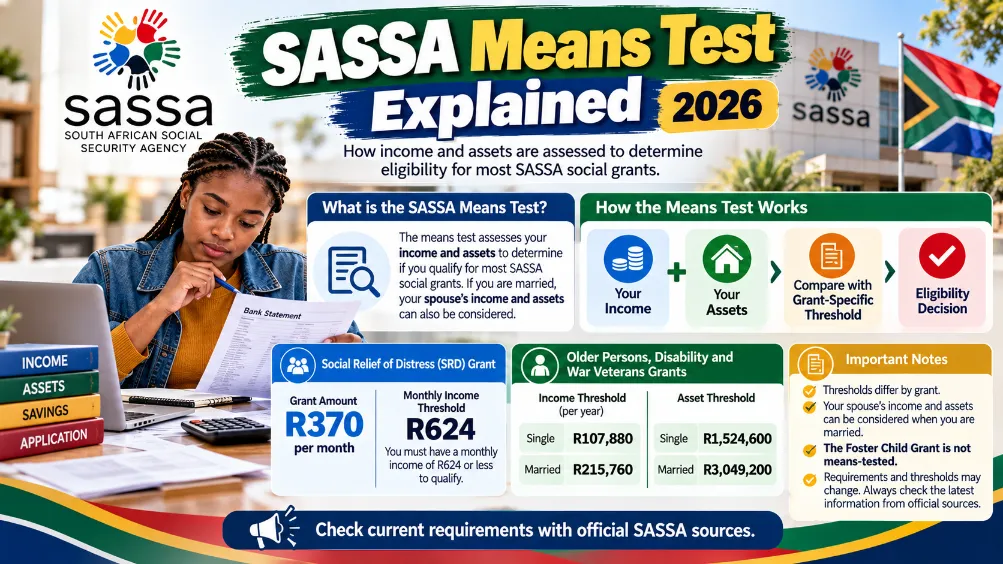
SASSA Means Test Explained: Asset & Income Threshold
The SASSA means test checks an applicant’s financial position against set income and asset limits. The South African Social Security Agency uses this assessment to determine financial eligibility for several social grants.
The limits vary by grant. Some grants use income and asset ceilings, while certain child-related grants use income ceilings.
For married applicants, the assessment can use the combined financial position of the applicant and spouse. A single applicant uses the individual limit for the relevant grant.
SASSA Income and Asset Thresholds for 2026/27
The following limits apply for the 2026/27 financial year:
| Grant | Single Annual Income | Married Annual Income | Single Assets | Married Assets |
|---|---|---|---|---|
| Older Persons Grant | R112,200 | R224,400 | R1,584,000 | R3,168,000 |
| Disability Grant | R112,200 | R224,400 | R1,584,000 | R3,168,000 |
| War Veterans Grant | R112,200 | R224,400 | R1,584,000 | R3,168,000 |
| Child Support Grant | R69,600 | R139,200 | No separate ceiling listed | No separate ceiling listed |
| Care Dependency Grant | R288,000 | R576,000 | No separate ceiling listed | No separate ceiling listed |
Applicants must also meet the non-financial requirements attached to their grant category, such as age, residency, caregiving conditions or medical criteria.
Monthly Income Limits
For easier budgeting, the annual ceilings work out to these monthly equivalents:
| Grant | Single Monthly Amount | Married Monthly Amount |
|---|---|---|
| Older Persons Grant | R9,350 | R18,700 combined |
| Disability Grant | R9,350 | R18,700 combined |
| War Veterans Grant | R9,350 | R18,700 combined |
| Child Support Grant | R5,800 | R11,600 combined |
| Care Dependency Grant | R24,000 | R48,000 combined |
These monthly amounts result from dividing each annual ceiling by 12. Formal assessment follows the annual limits and rules applicable to each grant.
Grants With Income and Asset Limits
The Older Persons, Disability and War Veterans grants share the same financial ceilings for 2026/27.
A single applicant can have annual income up to R112,200 and assets up to R1,584,000. For a married applicant, the combined ceilings are R224,400 in annual income and R3,168,000 in assets.
Both parts of the financial test apply. Falling within the income ceiling does not automatically satisfy the asset requirement.
Applicants must also meet the separate eligibility conditions for their grant. For example, the Older Persons Grant carries an age requirement, while the Disability Grant requires the applicable medical assessment.
Child Support and Care Dependency Income Limits
The Child Support Grant has an annual income ceiling of R69,600 for a single caregiver and R139,200 for a married caregiver.
That works out to R5,800 per month for a single caregiver and R11,600 combined per month for a married caregiver.
The Care Dependency Grant has a higher ceiling:
Single caregiver: R288,000 per year
Married caregiver: R576,000 combined per year
Single monthly equivalent: R24,000
Married monthly equivalent: R48,000 combined
Care Dependency applicants must also satisfy the medical assessment requirements related to the child.
What SASSA Checks During a Means Test
The financial assessment can examine resources relevant to the grant application. Applicants may need to supply supporting records during an initial application or later review.
SASSA may assess:
Income received by the applicant
A spouse’s finances where applicable
Savings and other financial resources
Property or assets covered by the applicable rules
Changes in financial circumstances
Information supplied during a grant review
Applicants should provide accurate financial details because changes in income or assets can affect eligibility.
Income Threshold Versus Asset Threshold
Income and assets cover separate areas of an applicant’s finances.
Income covers money received from relevant sources under the applicable grant rules. Assets cover financial resources or property assessed under the relevant means-test rules.
For example, consider a single Older Persons Grant applicant earning R96,000 per year with assessable assets worth R900,000.
The income falls below the R112,200 annual ceiling, while the assets fall below the R1,584,000 ceiling. Based solely on these amounts, the applicant falls within both published financial ceilings. Other eligibility requirements still apply.
An applicant earning R120,000 annually would exceed the R112,200 income ceiling, even with assets below the permitted asset limit.
How Marriage Changes the Means Test
Marital status affects the financial ceiling because married applicants can have their combined financial position assessed.
For the Older Persons, Disability and War Veterans grants, married applicants have a combined annual income ceiling of R224,400 and a combined asset ceiling of R3,168,000.
Child Support and Care Dependency limits also provide separate amounts for single and married applicants.
This distinction makes marital status an important part of the financial assessment rather than simply doubling an applicant’s personal earnings allowance without regard to household finances.
Financial Documents SASSA May Request
Required paperwork depends on the grant and the applicant’s circumstances. Financial records may cover:
Bank account information
Proof of earnings
Pension income
Spouse income details
Property information
Savings records
Other financial resources
Supporting records requested during a review
Applicants should provide current information that matches their actual financial circumstances.
Does Having a Job Affect the SASSA Means Test?
Employment alone does not determine eligibility.
An employed applicant may remain within the applicable income ceiling. The financial result depends on assessable income, marital status and assets for grants carrying an asset ceiling.
For example, a person earning below the relevant annual limit does not fail the income test solely because the money comes from employment.
Accurate disclosure remains necessary during the application and review process.
SASSA Means Test and Grant Reviews
SASSA can reassess financial eligibility after approving a grant. A beneficiary selected for review may need to submit updated information about income, assets or other financial circumstances.
A review can examine:
Current earnings
Additional income sources
Spouse finances
Relevant assets
Changes since the original application
Differences between current records and earlier declarations
Beneficiaries receiving an official review request should respond within the stated period and provide the requested documentation.
Can Extra Income Affect an Existing SASSA Grant?
Yes. Extra income can affect an existing grant where the beneficiary’s assessable financial position moves beyond the applicable ceiling.
A change does not have to relate solely to employment. Other financial resources covered by the applicable rules can also affect an assessment.
Beneficiaries should report relevant changes in their financial circumstances rather than waiting for a later review to identify a difference.
SASSA Means Test Threshold Summary
For 2026/27, the Older Persons, Disability and War Veterans grants share a single-person income ceiling of R112,200 per year and an asset ceiling of R1,584,000. Married applicants have combined ceilings of R224,400 in annual income and R3,168,000 in assets.
The Child Support Grant income ceiling is R69,600 annually for a single caregiver and R139,200 for a married caregiver.
The Care Dependency Grant income ceiling is R288,000 annually for a single caregiver and R576,000 for a married caregiver.
Applicants close to a financial ceiling should check the latest SASSA requirements before applying or completing a review because monetary limits can change across financial years.